

Arclight is a long-form interview series in which Women Who Weld, a 501(c)(3) nonprofit organization that teaches women how to weld and find employment in the welding industry, showcases former Women Who Weld participants who are responsible for bringing together a range of buildings, infrastructure, and products and services we rely on day-to-day.
Ashley Miller completed Women Who Weld’s Intensive Welding Training Program in March 2023. She is a second-year apprentice with Ironworkers Local 401 in Philadelphia, PA. Below is an edited and condensed interview between Samantha Farrugia, the founder of Women Who Weld, and Ashley, a former Women Who Weld participant, in August 2025.
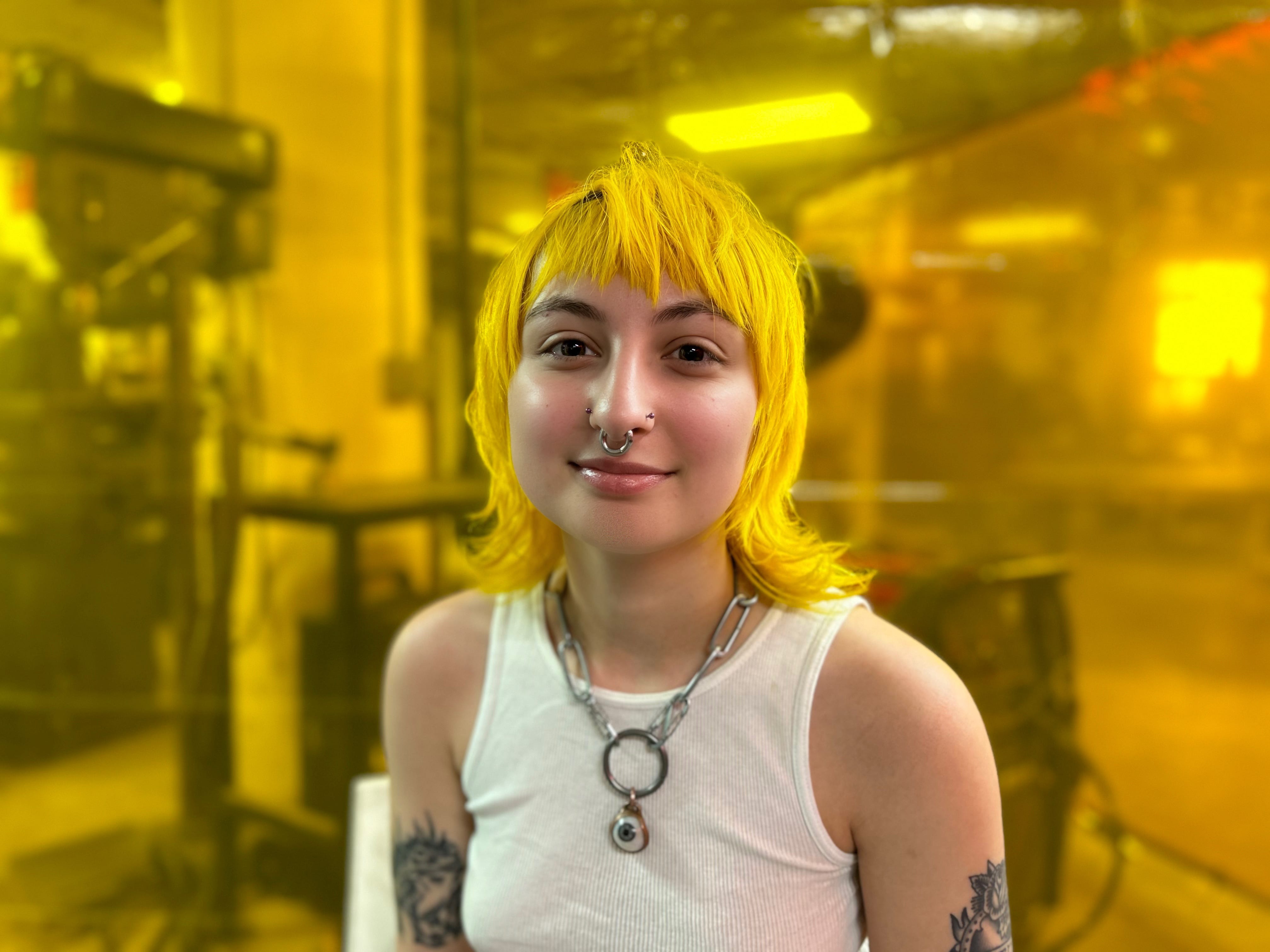
Where are you calling from?
Philadelphia, Pennsylvania.
Where did you grow up?
I grew up in Northern Virginia and moved around a little bit. I ended up going to college in Allentown, Pennsylvania. I have a lot of family in Pennsylvania, so that’s how I ended up here.
How did you find out about Women Who Weld?
I was in college for art with a concentration in ceramics and pottery. When I was nearing the end of my degree, I was like, “Well, what do I do now? I can’t really make a whole lot of money off of pottery,” so that’s when I found Women Who Weld. I actually went to an all-women’s college and tried taking a welding class at a local welding school, but being in an all-women’s academic environment and going to a male-dominated welding school was a total culture shock, so I tried to find something that would balance that out, and that’s how I found Women Who Weld.
And now as an Ironworker, you’re working mostly among men, all day, every day?
Yes, definitely mostly men!
So, you received a bachelor’s degree in ceramics, but you didn’t pursue your major as a career due to a lack of opportunity?
Yes, exactly. I would look on Indeed for actual jobs and it was like, “Ceramics studio assistant, part-time, $15 an hour,” nothing you could possibly live off of. Or if I wanted to be an artist and sell my work, that takes all the fun out of making stuff.
Are you in any student debt from college?
Yeah, about $25k. It’s not too bad compared to most student loan debt that people end up with, but it still feels like a lot.
Why welding? What sparked the interest?
My dad mentioned it to me forever ago and I kind of brushed it off, but I also kept thinking about it, like, “Well, maybe…” So I watched a YouTube video of welding and thought, “That looks scary…” but I also like scary things! And I’m good at making stuff; I’m good with my hands and welding is a form of creating things, so I felt it matched by abilities and mentality about the world. It just fit.
So, your dad told you about Women Who Weld. Is he a welder?
He is a professor; he teaches exercise physiology, so totally different from welding. He probably just knew I would be good at it.
Where did you work as a welder prior to becoming an apprentice with the Ironworkers?
After I completed Women Who Weld, literally within five days, I got a job making refrigerated box trucks at Morgan Truck in Morgantown, Pennsylvania, making $23.50 per hour with a raise to $27 per hour within just a couple of months. I worked there for about 6 months, and then I moved to Arizona briefly and worked in a small shop making commercial water heaters – that was a hot job. Then I moved to Philly and I started working in a plant making dumpsters – that job sucked. And that’s when I started pursuing the union here.
How amazing that after our week-long (five-day) intensive class, you secured a job within five days and a significant raise within a few months!
I moved around a lot the first year after college and I was able to find three different welding jobs in one year. I was able to find jobs anywhere I was, and I went from being an assistant manager at a beauty store making 16 bucks per hour, which was high for that store, to starting lowest tier at Morgan Truck at $23.50 per hour, which was a significant raise for me.
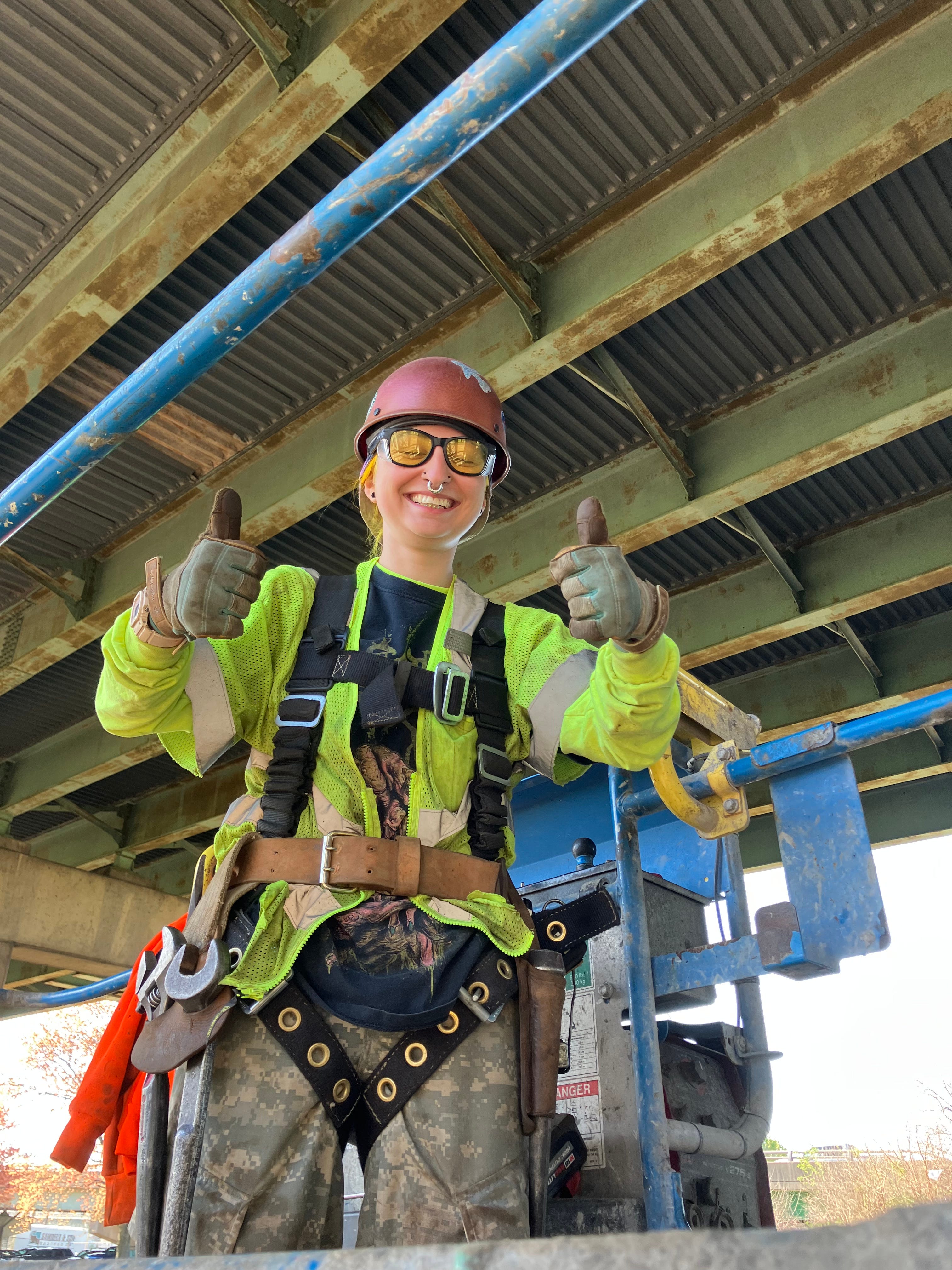
You’ve been an apprentice with Ironworkers Local 401 just over a year then?
Yes, I just got my second-year rate on July 1.
What was the application and acceptance process like?
In April or May 2024, there was one week where they opened up applications and you had to physically go in, pick up a packet, and apply at the apprentice training center. It’s a good opportunity to show your face. I had it all scheduled out: I went in as soon as I got off work the Friday that applications opened. I knew I had to go as soon as possible, and not on the last day, because they want someone with moxie. Nepotism is a big issue so you have to stand out somehow. So, I picked up the application and returned it in-person. You should go in there loaded with questions. When I picked up my application I asked, “When can I start working?” They said I didn’t need OSHA certification for the application, but I would need it if I wanted to start working, so I was like, “Okay, I’m going to get it anyway, even if I don’t need it now.” And then I got an email that I could go out and work before everyone else because I had my OSHA certificate. It’s important to do the optional things.
After I got the email to work, and I had been out working a few months, I had to take a physical dexterity test and a written exam. The written exam was easy: basic multiplication, fractions, drawing lines through a maze. The physical test involves walking a beam, climbing a column, doing pull ups, lifting up an impact gun. I thought the physical test was kind of hard. Climbing a column is harder than it looks. I can't do a pull up, but I can almost do a pull up. All of these aspects of the application process are cumulative. So if you do really, really shitty on the physical exam, but you do really, really well on the written exam, they'll balance each other out, and then the last step is an interview, and you get points for that too.
Do you know how many people applied the week applications were open?
I'm pretty sure I heard someone say it was like 300 or something, a huge number.
Do you know how many people were accepted into your cohort?
About 30, which is actually larger than usual.
Are you with that group of 30 regularly?
When classes are going on I see them, or during meetings I see them, but I'm also only with 15 of them. Since there were so many people, the class was split into two groups. There are less people now because people quit or whatever.
Do you know why some people quit?
Often from not passing a drug test, or a personality issue like not being able to take shit but being able to dish it out. I've heard about a couple of dudes who want to talk shit, then someone says something back and they can’t handle it.
Do you know how many other women are in your local?
There's six women in the local and I'm pretty sure that’s out of about 600 active and inactive members.
Several trade unions engage in welding, including the Boilermakers, Carpenters, Ironworkers, Millwrights, Pipefitters/Steamfitters, Sheet Metal Workers, and so on. Why did you choose to become an apprentice with the Ironworkers?
I would say that number one is because it's super cool. I saw dudes up on columns connecting and I thought it was the coolest shit ever. I like heights, I like doing adventurous things like that. Also, the written test was a little bit less complicated than all the other options, so it was the path of least resistance with the coolest people.
Where do you currently work and how long have you worked there?
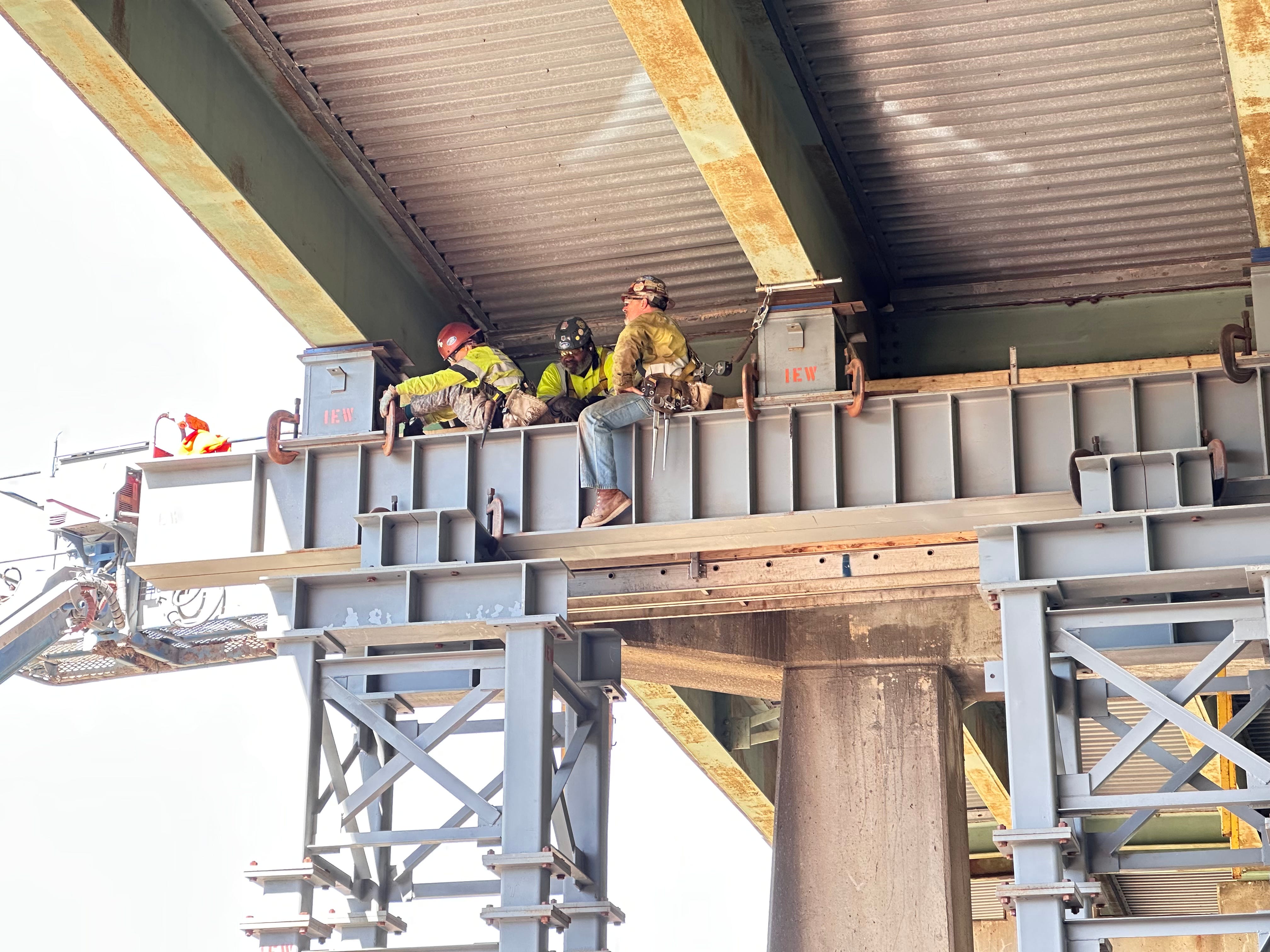
The company is IEW and they're based in New Jersey, but they do a lot of bridge work around the Philadelphia, New Jersey, and New York area. There are two main highways in Philly: 76 and 95. And we are on this long strip of 95 replacing bearings and diaphragms and other things underneath the bridge.
Are cars actively on the bridge?
The cars are on top of us, it’s an overpass.
Have you worked on any bridges over water?
Not yet, I hope to. When I drive over the really big bridges, like the Ben Franklin here, and I see those really tall cables and side poles, I want to go up there.
We've had former participants who helped build the new bridge from Detroit to Canada, which will open up in the next year; working on an international crossing is a pretty unique experience.
Have you worked with IEW since you started your apprenticeship?
No, because I was one of the first people to go out of the hall and get a job from my class, and because I was working almost all summer as an applicant, I bounced around and I've been on six or seven jobs now. This job started in January and they told me it's a three-year job, so I'm going to basically finish my apprenticeship on this job.
What types of jobs did you work on before this bridge project?
There are different categories of ironwork: structural, bridge, ornamental, miscellaneous. I’ve had a couple of warehouse structural jobs and a couple of miscellaneous jobs. I’ve really done a lot with this union already, and I've only been in it for a year and a half.
When do you become a journeyworker?
The apprenticeship is four years, and I'm already done with year one, so three more years.
What’s your schedule like, including start and end time, each day? Which days of the week do you work?
Monday to Friday, and since it's summer and it gets hot, we're starting at 6 a.m. and getting off at 1:45 p.m. because we're only taking one lunch break and not our other coffee breaks so we can get off early. But during the winter it's 7 a.m. to 2:30 p.m., and then occasionally there’s an emergency repair where we might have to do an overtime or an overnight shift.
Describe a typical day on the job.
Every day is a little bit different. Currently, we're building these steel towers underneath each pier of the bridge and using this huge hydraulic jack that weighs like a bajillion pounds, and we're jacking the bridge up so we can pull out the old bearings and put in the new ones. The new bearings get welded in and I'm often fire-watching for that. Sometimes I get to weld stuff. We’ll use an oxy-torch to demo the old bearings. It’s heavy problem-solving work.
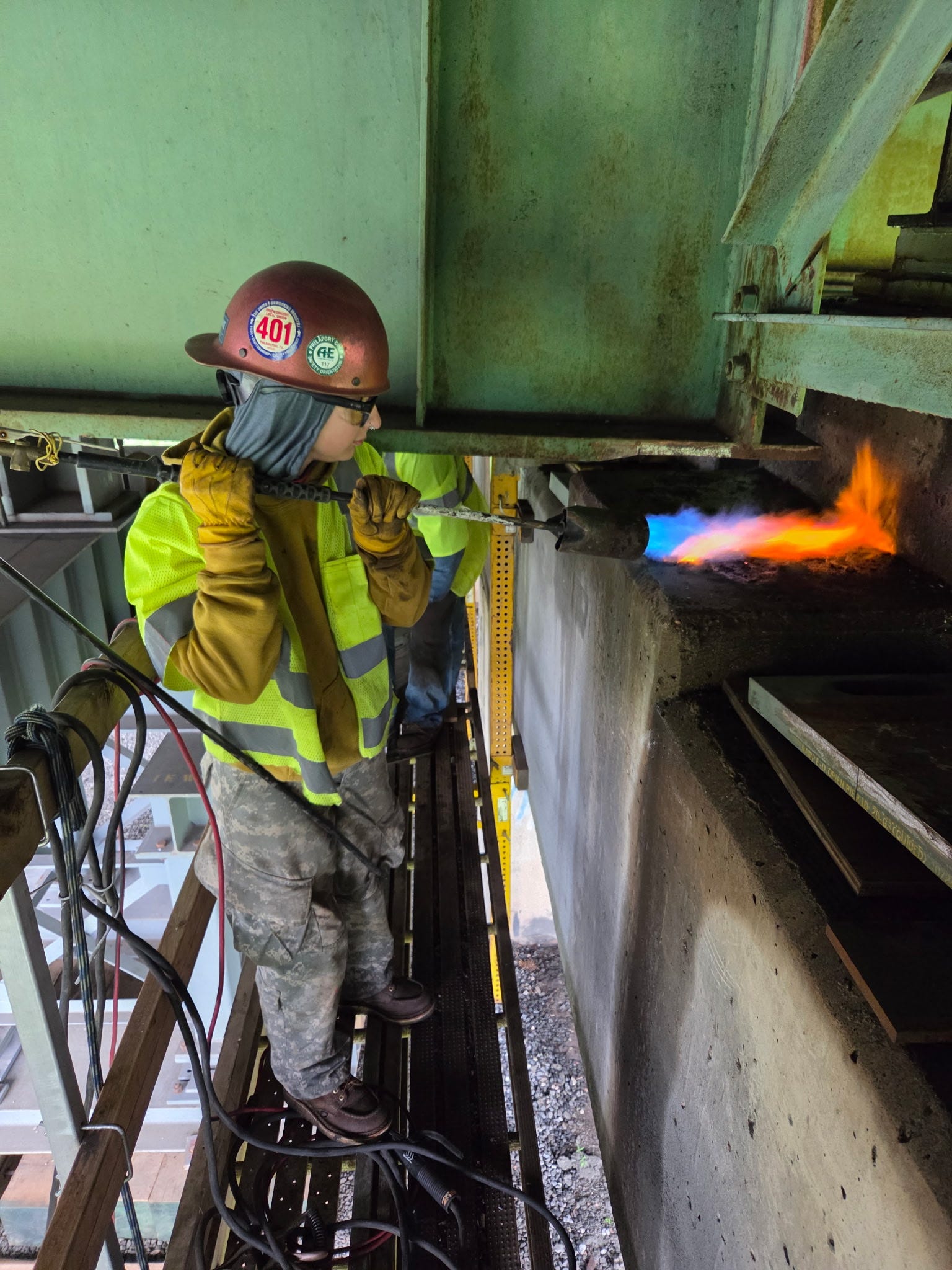
When you're using the hydraulic jack to jack up the bridge, are cars still actively crossing it?
Yes, and it's kind of freaky, because we use a pump with hoses that go to the jacks, and as the pressure goes up, you have to pay attention to the gauge to make sure you're not applying too much. But when huge trucks drive over the bridge right where you're jacking, the gauge needle will jerk and you feel it, or even when you’re standing on the ground and something huge drives over the bridge, the whole ground vibrates and it's loud.
You're out in the elements, it’s summertime, it’s hot, it’s loud, and the work is dangerous if someone is not paying attention, but you find the thrill in all of that.
Yeah, yeah, for sure. I like climbing shit and being in places where people normally don't go. The project I’m working on is right by the Eagles Stadium and it's right next to where all the police park when Eagles games are going on. It’s this little spot where no one would normally be and I feel like a VIP because I get to access these places.
What is your hourly pay if you’re comfortable with me disclosing it?
Of course, I want people to know how much you can actually make doing this! As a second year, I make $39 an hour. It would have been $37, but we just received a new raise for the whole union, so now it’s $39. I started at $32 as a first year: you start at 60% of journeyman rate, and you gain 10% every year until you journey out and become a journeyman. And on top of the rate that goes into your check, you're also making an additional $15 an hour that goes into your annuity.
And you also receive health benefits?
Yeah, you have to work a certain number of hours a week to maintain your benefits, but you accumulate points or hours each week so that if you're ever laid off, you have these saved hours that will continue your insurance. It’s really good insurance, it has vision, dental, all that stuff.
Which welding process do you primarily engage in?
Primarily stick but sometimes flux-cored, it depends on the job. A lot of structural jobs that are super focused on production and speed will have more flux-cored on the job. But for this job, since we move around so much it’s easier to grab a handful of rod than it is to lug around a whole flux-cored box, we use stick for pretty much everything.
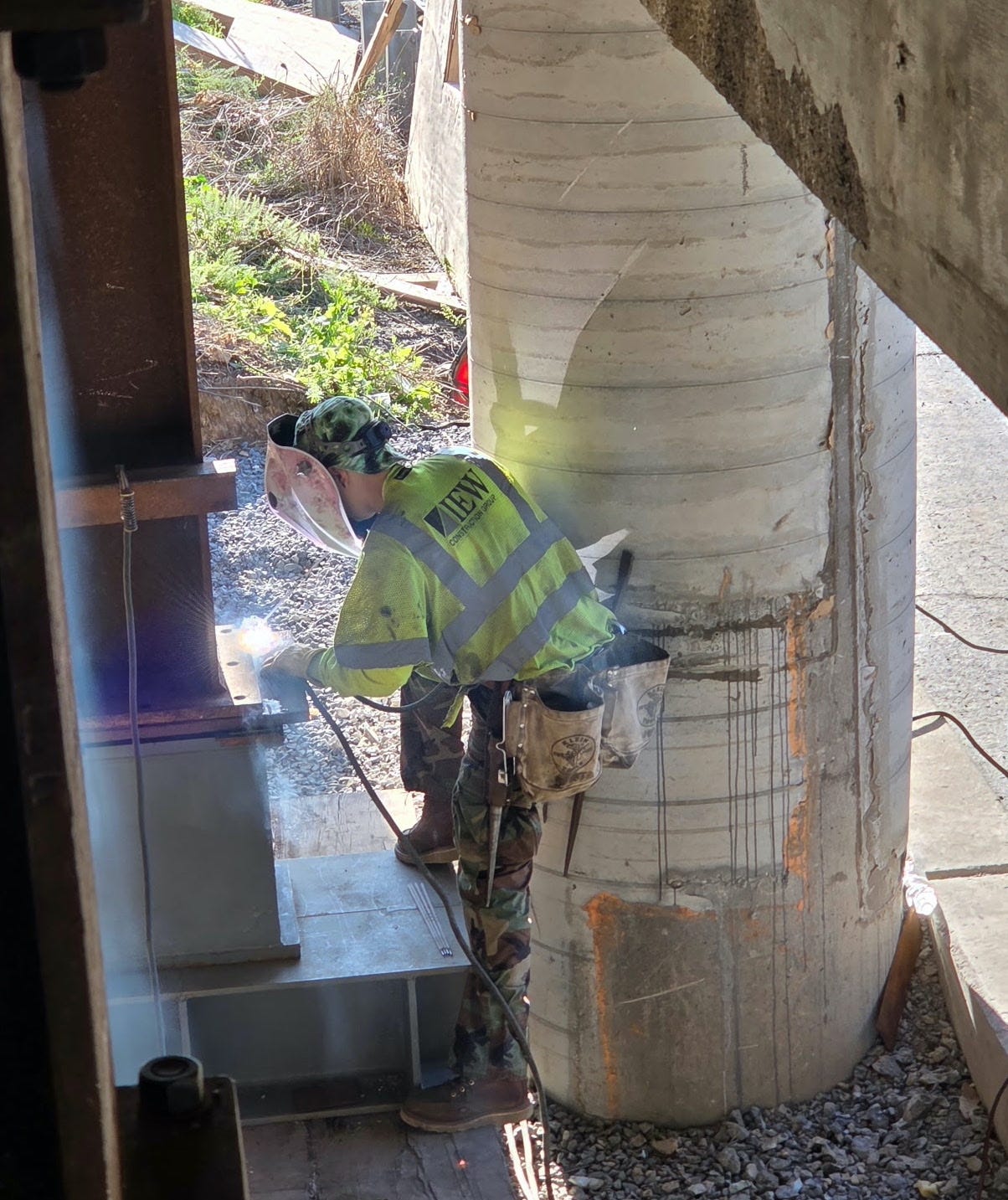
When you are not welding, what other things are you doing?
Fetching tools, sorting bolts, fire-watching. Fire-watching is the worst. Well, sometimes it's nice. It's a nice balance. Like, if I spend a whole day lugging heavy ass shit around, I would love a day to fire-watch.
What’s your favorite welding process and why?
Either stick or TIG. I’m not good at TIG, but I appreciate how clean and comfortable you can be when doing it. Stick is really nice because you don't have to be so particular about the angle of the rod unlike MIG. And with MIG there's the whole element of using gas, which is kind of annoying. I think having flux on the rod so you can just lap it in there and go is so nice.
What sort of tools and equipment do you use regularly?
I wear a harness and a belt at all times, even if I'm fire-watching. I have two bolt bags, a connecting bar, an adjustable spud wrench, a 7/8” spud wrench, and a bull pin. In one bolt bag, I have a 4-pound beater and I sometimes carry around an 8-pound beater depending on what we're doing. In my other bolt bag, I have a tape measure, a torpedo level, a striker, and any other little random things I might need depending on what we're doing. Those are the main things I carry around.
That’s a lot of weight on your hips!
If it's a day in which I need to carry my connecting bar and 4-pound beater all day, my hips will start to burn. And because I'm so short, the top of the connecting bar will hit my elbow and the bottom will hit my calf when I'm walking!
Have you gained strength and put on additional muscle since becoming an ironworker?
Yes! The first job I got, they sent me out to this warehouse, a huge, huge warehouse, and I was in the decking gang. So, I was on the roof, and all I was doing was using, like, a pogo screw gun to screw deck. It was two or three weeks of screwing deck, eight hours a day, and at the end of the first day I thought, “I'm not gonna make it, my arms are jello. I'm dying.” And then by the end of the two or three weeks, I was pumping them in and my arms were crazy after that.
You had reached out to me when you were searching for a pair of ironworking boots in your size, did you ever find a pair that worked?
There’s a specific kind I want. I want an 8” tall boot with a wedge sole and a round toe, because a moc toe is not good for welding as sparks will catch in it and burn it up; a round toe is ideal. I emailed all the boot companies: Danner, Brunt, Carolina, Thorogood, Red Wing, and I was like, “Please offer women's boots!” because none of them had what I wanted. And then, in the fall of last year, Thorogood released their first women’s boots and I got a pair, but I haven't found the round toe yet.
Which materials have you welded on?
For ironwork specifically, it's pretty much always mild steel. But I’ve welded aluminum and stainless steel. I did a lot of stainless MIG and TIG when I worked in Arizona.
Why did you leave Arizona?
I was only there for about four months. I pretty much just missed my family, I missed my friends, I missed all my people. And I was like, “Why am I starting over when I had so much great stuff over there?”
You told me recently that you worked at your apprenticeship training hall as a welding instructor for a girls summer camp. What was that like?
In my union this summer they had summer camps come through to learn different things. And a summer camp of young girls, ages 12 to 17, were touring all of the unions around here, so my local asked me to teach them how to weld! And I'm so glad they asked me do it! I like doing stuff like that: where I get to teach women and girls that one, welding is not scary, and two, it's very possible and you're probably really good at it and there are so many careers that you could do. Being able to teach makes the work feel so much more worth it; it reassures me that I'm working really hard for a reason, other than just for money.
How many girls were in this group and was it just one day or multiple days?
It was one full day, eight hours. There were 30 to 40 of them. They were split up into three groups and there were three stations. There was a guy teaching them shop stuff in a mock-up building room where they got to put together stairs. There was a classroom station, and there was a welding station. So, the welding teacher and I would each get a group of maybe 10 of them and we would teach them how to weld, and then they moved on to the next station and we would get a new group.
Did they have fun welding?
They all said welding was their favorite section of the whole thing! Some of them were actually really good. And we were teaching them stick welding. I would say that stick is probably one of the hardest processes to learn at first. I think it's easy to get good at, but it's hard to strike an arc. And trying to teach 12-year-olds to do that within an hour or two is challenging. Some were really good and they picked it up quickly. And some were so scared.
I had never taught anyone how to stick weld before and I was thinking, “I don't even know where to begin,” so I ended up running a path and showing them, and then I put the stinger in their hands with my hands around theirs to guide them through it so they could still feel it. Which is how I learned at Women Who Weld! Like, you physically made my hands do what they had to do, so I thought, “That worked for me, I'm going to do that for them.” And it worked so well!
That’s amazing! Several other former participants have also held welding lessons for girls or women, either through their union, in higher education, or their own shops as small business owners, and it's so cool to see the literal torch being passed among hundreds of people.
After I did Women Who Weld, I was like, “That's what I want to do.” I didn't just want to weld. I knew I loved welding from the moment I took the class, but I knew I could do more than just that and I feel so grateful I’m already doing it. Like, I've only been welding for two years and I'm already with my union teaching young girls to do it, it's the coolest fucking shit ever. It was an honor to teach girls and share my experiences. I never would be where I am today without Women Who Weld, it changed my life.
What are your future career goals?
I'm really open to anything. But after teaching girls how to weld, some of the instructors were putting a good word in for me to become a teacher for the apprenticeship after I journey out. So, I think there's definitely real teaching opportunities for me with the union in the future. I'm also open to maybe teaching full-time. Our work is hard and, in the future, I know there are other ways I can incorporate welding into my life in a fulfilling way that's not so draining. I do often find myself searching for ways where I can still weld and help other people weld, but not have to ironwork all day then go be an instructor for the hall right after I get off work. That sounds like a lot, but it also sounds awesome. I'm open to whatever opportunities arise for me.
I think you would make a fantastic instructor. You're clear, detailed, personable, and creative, and there is an art to teaching; you have a personality that would reach a lot of people, so I think you should definitely pursue that path if it arises for you!
My dad's a teacher. My mom does really early childhood teaching, so educating and nurturing are definitely in my genes. I love being a disarming person for young women and girls who are scared of the trade like I was when I started.
How old are you?
I’m 26 right now, I’m about to be 27 in September.
What are the things you like most about being a welder/ironworker?
I love welding. I love putting my hood down and feeling like I'm in this whole other world, totally by myself. The sensory act of welding just feels good. I can feel it in my soul that I like welding, I love it. Ironwork itself is kind of a means for me to weld where I get paid. If I could just weld all day, that would be great. The other aspects of ironworking are cool and necessary, but they're just breaks from welding. Welding is what I really look forward to. But I also like climbing stuff. I like being high up in the air.
What are some challenges you’ve encountered as a welder/ironworker, if any?
The physical aspect is pretty challenging, because sometimes it can just be embarrassing, honestly. If I'm at the dexterity test with 100 dudes, and they're all doing pull ups like it's nothing, and I'm over here fighting for my life, trying to do one pull up, it’s kind of embarrassing. But then there are other situations where I excel and they don’t, so it makes up for it. I feel like a lot of dudes, the way they're raised, they're more trades-minded. There aren’t many people in my immediate family that are in the trades. I never touched a fucking tape measure before I did this. I didn't know anything. I'm coming in super green, and that learning curve can be very, very frustrating.
Do you have advice for women who may be interested in pursuing a path in welding/ironworking?
One thing I always kind of tell myself, whether it's good or bad, I don't know, it works for me, is that if a man can do it, I can do it. Once welding became something I thought was possible, I was like, “Oh, okay, I'll just do it.” And then I did it. If you have an unwavering sense of near delusional confidence, you'll be able to do anything. It literally works to think you can do things.
“It was an honor to teach girls and share my experiences. I never would be where I am today without Women Who Weld, it changed my life.”
What do you like to do in your free time?
I like to read a lot, because when I get off work and I've been outside all day, the last thing I want to do is something hard. So I just sit on the couch and read, or I'll watch TV with my partner, or I will sit in front of my frog tank and look at my frogs or my tarantula or my snake.
If you were not a welder/ironworker, which career path may you have chosen?
Oh my gosh, I don't even know. Is money an issue? Like, is this something that would still pay the bills? I think if money were not an issue, I might have a cat sanctuary. But if money is an issue, I think I would try to do something like coding, or something remote on a laptop where I could go on vacation and be at the beach for like three weeks and still do my job from the beach.
While in Women Who Weld’s intensive training class, you mentioned your goal was to one day be interviewed for Arclight, and just over two years later, here we are!
When I got the email asking me to do this, I was like, “Holy shit, I said I was gonna do it, and now I'm doing it!” It's so satisfying.
If you could travel anywhere, where would you go and why?
Vienna, Austria, because there's a museum there that has my favorite painting. It's “The Kiss” by Gustav Klimt. That's where I would go because I want to see it.
I love reading about the participants from WWW classes and what they are doing now. It's so exciting, inspiring, and heart-warming to see how women from all walks of life and circumstances somehow find WWW and transform their lives in so many fascinating directions!
Thank you for this great interview!